JASON HALF : writer
  • Home
  • Full-length Plays
    • Kate and Comet
    • Sundial
    • Tulip Brothers
  • Short Plays
    • Among the Oats
    • Holly and Mr. Ivy
    • Locked Room Misery
  • Screenplays
    • The Ballad of Faith Divine
    • My Advice
    • Finders
  • Fiction
  • Blog

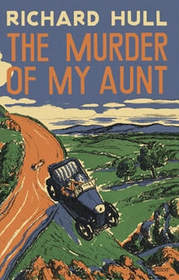
Book Review: THE MURDER OF MY AUNT (1934) by Richard Hull

9/7/2018

0 Comments

 
Picture
I have been thinking a lot lately about the role that characterization plays in mystery fiction past and present. It's an intriguing exploration, because one could argue that mystery stories (or any literary genre defined by a particular structure) only need character types to work, and not necessarily characters with sincere or striking traits or personalities. To this end, one has a detective, a victim, assorted suspects, and perhaps a Watson to act as proxy for the reader. With people in place, the author can then manipulate the characters like chess pieces and effectively play out the game. And just as chess pieces are familiar in role but nondescript in detail – we don't know more about our bishops, knights, or rooks beyond their functional maneuverability – a mystery writer can present game after game using the same characters making the same familiar moves on the board.

Of course, any type of fiction is enhanced when a writer manages to deliver engaging characters caught up in a compelling plot, with an original tone supporting both story and theme. (Easier said than done.) This explains why I prefer imaginative writers who experiment and take risks – and occasionally fail – to those who work from a tried-and-tested template. Personally, I'm far less interested in the puzzle than in how the mystery format can be used to say something about the characters and, by extension, about humanity. It's why I'm lukewarm on clever puzzle constructors like Ellery Queen and John Dickson Carr, and why my favorite Agatha Christie books are not Poirot baffle-fests but instead And Then There Were None and The Mirror Crack'd, two titles where the psychology of the killer is both memorable and carries a note of human tragedy.

It is also why I read and reread the books of outside-yet-within-the-genre writers Gladys Mitchell and Richard Hull.

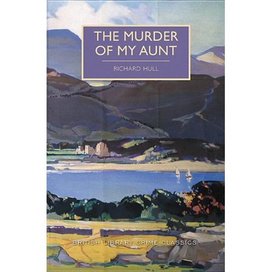
The Murder of My Aunt is Hull's first mystery novel, and the one he was compelled to write after working for years as a chartered accountant. It is one of those début books where the exuberance of the author alive to the possibilities of plot and prose and language is evident on every page. Hull chooses as his narrator a conceited, comically misanthropic young man named Edward Powell, who is unhappy with his stifled life in the small Welsh village of Llwll (pronounced, if Edward is to be believed, as "filth") in general and with his disapproving, domineering aunt in particular. As we learn of Edward's opinions and grievances through his confidences in detailed diary entries, we also learn much about his character. This is one of the book's most enjoyable gambits: Hull creates a narrator who is both sympathetic (perhaps pitiable is more accurate) and shallow. One can understand the circumstances of his frustration, but he's also greatly at fault due to his vanity and laziness, as he has no interest in pursuing an independent life and means of income. He is lazy, that is, until he decides that the murder of his aunt would provide freedom and a useful inheritance to boot.

Returning to those elements of strong fiction, Richard Hull incorporates all three with purpose, wit, and a great deal of ironic humor. The plot can hardly be bettered: one person wants to kill another, but the victim refuses to cooperate. In fact, as we only know what Edward reports, we get the feeling that Aunt Mildred might know more about the situation than our diarist thinks, and that creates an excellent mounting tension which connects directly to two age-old dramatic questions: What will happen next? and Who's going to win? Making both Edward Powell and his aunt well-delineated adversaries through personality and motivation, Hull offers up characterization that is as sharp and specific as anything he would later deliver. Further, the book's witty comic tone (for those who appreciate it; not all mystery readers do) is a terrific success. Edward's observations are amusing throughout, and the recounting of an incident where he tries to purchase oxalic acid and instead winds up buying a Christmas card in September is laugh-out-loud funny.
Picture
There is a neat concluding twist that I will leave alone, but it is memorable enough for me to recall from my initial reading of Aunt some decades ago. It was also this book that made me vow to find and read each of the author's fourteen other crime stories, and slowly but surely I am doing just that.

You can check out Kate's great review of The Murder of My Aunt at her crossexaminingcrime site. The book is getting a welcome reprint release from the British Library Crime Classics series and Poisoned Pen Press, presented with a great introduction by scholar and author Martin Edwards. I received an advance eBook copy through NetGalley in exchange for an honest review. 


0 Comments

Book Review: INVITATION TO AN INQUEST (1950) by Richard Hull

4/15/2018

2 Comments

 
Picture
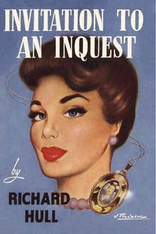
It can be capably argued that mystery author Richard Hull had an affinity for creating disagreeable characters. His books are populated with egotists and misanthropes, and perhaps his most common narrative perspective – as is evidenced in enjoyable books such as The Murder of My Aunt (1934), Murder Isn't Easy (1936), and My Own Murderer (1941) – is that of the self-satisfied schemer who turns out to be too clever by half. In contrast, 1950's Invitation to an Inquest presents three central characters that are so unlikable and circumlocutory that they move swiftly from antihero into the realm of pedant and bore. It doesn't help that neither the mystery at this story's heart nor the motive for murder are of much interest to the reader.

At the book's beginning, Inspector Yarrow is patiently interviewing Charles Kerrison, who may have witnessed a removed cousin jump into the Thames from the Waterloo (or perhaps it was the Vauxhall) Bridge. William Bowman has been dragged from the river, and Yarrow investigates his fiery relationship to the Ayres family, the meaning of an heirloom locket that Bowman would never pawn despite his desperate need for money, and the theft of payroll cash where he worked.

Yarrow also interviews the combative Felicity O'Shea, housemaid to Meredith Ayres and, improbably, both common-law wife to Bowman (who was never divorced from his first wife) and an ex-worker at the same electroplating factory where the payroll theft occurred. The Inspector also visits the elderly, caustic patriarch Meredith Ayres, who has contempt for Charles, his nephew once removed, and enjoys watching Felicity upset his house staff. And his ailing niece Mary may or may not have died from a purposeful window draught while staying at his home.

The novel's most obvious flaw is the aforementioned lack of relatable, accessible characters. A story can succeed using unsympathetic antiheroes, but they need to generate some sort of reader interest, even if it's only to see whether they receive their comeuppance. With Invitation to an Inquest, my reaction was consistently "Just get on with it" every time Charles Kerrison provided rambling details of the Night in Question. (The story starts after the deaths of William Bowman and Mary Ayres and the factory theft have occurred, which means that most of the storytelling is passive instead of active, and listening to various versions of what might have happened from one unreliable and conceited witness feels like padding to reach a page count.)  

As for Inspector Yarrow of the Yard, he too is a prototype commonly found in Richard Hull's stories: the competent but nondescript police detective, whose job it is to ask questions and yield the spotlight to the more outspoken suspects and witnesses he encounters during the investigation. This tabula rasa approach can also work, but it means that if the detective figure isn't allowed to form a personality and hold his own as a figure of power, then the other characters will need to engage the reader's interest independently. Suffice it to say, that didn't happen for me here.

When one reaches the tepid conclusion and learns the rather silly grand scheme and the motives that the relatives might have had (barely a spoiler: they revolve around inheritance and the fine print in great-grandfather Samuel Ayres' last will and testament), it's difficult not to wish you had spent that time rereading one of Hull's better, earlier books instead. Ironically, Invitation to an Inquest is a fairly rare book to find – I needed to request a text photocopy from the National Library of Scotland after securing permission from the agents who represent the author's estate – but it is also one of the few Richard Hull mysteries (and perhaps the only one; I have four more Hull titles to read) that has almost nothing to recommend.

2 Comments

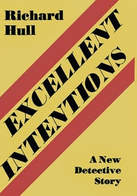
Book review: EXCELLENT INTENTIONS (1938) by Richard Hull

10/28/2017

3 Comments

 
Picture
In several of his inventive stories, Richard Hull experimented with some form of structural variation that offered a new approach to the conventionally plotted murder mystery. His first novel, The Murder of My Aunt (1934), told a darkly comic story of a narrator intent on killing his aging but wily relative; in The Murderers of Monty, it is homicide by committee; in Last First, Hull provides a climactic final chapter at the start and then uses the book to usher the reader to that point.

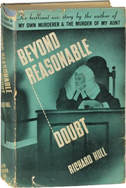
With 1938's highly enjoyable Excellent Intentions – published in the U.S. as Beyond Reasonable Doubt; the original title is more apt, if initially less criminous – the author presents a murder trial viewed from the perspective of multiple revolving participants, including defense counsel, prosecuting counsel, jury foreman, and judge. He also manages to keep the identity of the accused a secret for most of the book, which gives astute readers the chance to play detective.


The petty and unlikable Launcelot Henry Cargate (Hull's books are populated with petty and unlikable characters, often for the amusement of the reader) chooses to travel from his Essex estate into town by train when his automobile doesn't start. Entering the train car, he inhales a customary pinch of snuff and promptly dies. With a prisoner in the dock and the trial already underway at the start of the book, we soon revisit the days before the suspicious death, and then the subsequent investigation by Inspector Fenby, before catching up with – and hearing the verdict rendered through – the court.

Along the way, we are introduced to the suspects, including Macpherson, a rare stamp seller who was accused by Cargate of dishonesty; Raikes, Scotney End Hall's proper but harried personal butler; Miss Knox Forster, the dead man's personal assistant; and even Reverend Yockleton, who was not above the range of Cargate's animosity. Hardy, the caretaker, had been issued poison to eliminate a wasps' nest on the grounds, and it was this substance that had been ground and mixed with the contents of Cargate's snuff box.

While this story's shifting points of view could have created narrative problems, including a lack of cohesion and confusion over protagonists, the approach is actually quite successful. The longest chapter of the book focuses on Fenby's investigation and interviews of members of the household, and it is notably apparent that Hull is delivering the tone and plotting of classic Golden Age detective fiction while simultaneously satirizing the genre.

For one thing, the household is so wary of its misanthropic employer's penchant for accusing anyone of petty theft (while knowing the claim is a manufactured lie) that the servants have taken steps to elaborately alibi one another at all times. This practice works out handily when the prosecution wants to know who was in the dining room at what time, for instance. Study doors were also conveniently locked and witnessed to avoid the master of the house accusing the housemaids of mischief. Such timetable accuracy feels rather fanciful, but it is also the author's gently winking commentary on the artificiality of mystery stories. If a character is expected to die from taking poisonous snuff in a train carriage, then why not add the equally colorful conceit that the suspects have their comings and goings timed to the minute?

PictureCover for Beyond Reasonable Doubt, the U.S. title.
Excellent Intentions (and its structure) also benefits from a very enjoyable final twist from an unexpected source. To say more would be unfair, but I will add that Hull enjoys exploring the intriguing philosophical notion of a justified killing, not out of revenge or retribution but as a way to rid the world of a universal irritant, as one would eradicate a wasp and its naturally malignant personality. Richard Hull's dry yet playful sense of humor runs throughout the book – in the form of the fussy prosecuting counsel, in the family of village tradesmen that all share the same name and are identified through their vocation: Hardy the Baker, Hardy the Gardener, et cetera – and he has delivered an engaging story that uses the elements of Golden Age mystery fiction while also quietly deconstructing them. Recommended.

UPDATE: JJ at The Invisible Event has informed me that The British Library plans to reprint Excellent Intentions and The Murder of My Aunt in 2018, so watch for those releases, as both are very entertaining comic mysteries. The British Library's Crime Classics series, curated by Martin Edwards, continues to provide readers with opportunities to explore dozens of lesser-known and unjustly neglected authors, and nearly always the journey is worth taking.


3 Comments

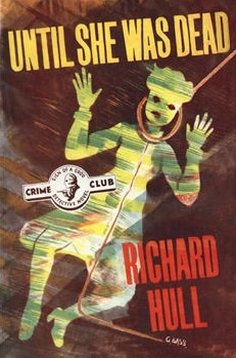
Book Review: UNTIL SHE WAS DEAD (1949) by Richard Hull

2/12/2017

0 Comments

 
Picture
Synopsis: At the beginning and end of this tale, we peer into the fitful mind of Ambrose Gray, Junior Counsel for the Prosecution, who is unable to sleep on the eve of an important trial. We know that someone has been killed at 17A Elizabeth Square and someone else may be hanged for the act, but whom? The answers are provided in flashback, where we meet the players in the darkly comic tragedy.

The eccentric matron of the house, an object-dropping, exclamation-stating lady of older middle age named Yvonne de Belmont, has decided to employ a companion to help her in the afternoons. Ever the contrarian, she sets her sights on Clara Fison, a young woman whose last employer (also an elderly lady) met her death under suspicious circumstances.


Mrs. de Belmont’s unconventional choice enrages her pessimistic nephew Arthur, who openly objects to anything that would put his aunt in harm’s way, although secretly he would welcome the opportunity to remove his controlling relation. Some clumsy previous attempts to persuade his aunt to will her money to him have only strained the situation further, and she is happy to twist the knife; Fison soon moves in, and Yvonne de Belmont begins to mischievously hint that she plans to leave her fortune to her new companion.

Mrs. de Belmont’s doctor, a plummy Scot named Holmes, may be a little too eager to see her prized stamp collection – was his presentation of an obviously forged St. Lucia stamp a pretext to gain access to her books? – and, shortly thereafter, indeed a valuable postal sheet goes missing. There is also a saturnine accountant named Sumner, tasked with maintaining the ledgers for the wine merchant service begun by Yvonne de Belmont’s late husband. There appears to be irregularities with the accounts, and Sumner is not at all happy that the widow sends Clara Fison to ask some pointed questions about the profit margins.

17A Elizabeth Square has a poorly lit foyer with a double staircase leading to the rooms, and it is in this limbo location where one hapless person falls into a trap that leaves the body suspended from a rope hung through an obscured skylight. Detective Inspector Oliver approaches the strange case with an optimistic demeanor, but soon has questions. Was the victim the intended target of murder? Who placed the sweeper against the skylight pane, making the already dark foyer even more difficult to navigate? Who rang the doorbell that summoned a person to their doom? Oliver sorts out the merely eccentric from the lethally inclined, and it is now up to Ambrose Gray, Junior Counsel for the Prosecution, to deliver a verdict of guilty.

Review: The elements that are working well in this later mystery by Richard Hull tend to be the ones for which he has exceled in the past. Once again, we have a somewhat unconventional framing device, as we are given some details from a junior barrister’s point of view, but other critical information is withheld until we get into the plot proper. It’s a tactic that’s not necessary, but it does help slightly in terms of novelty of approach.

For me, it is the dark humor with which the frustrated cast of characters is drawn that holds the most appeal. Mrs. de Belmont is a great minor creation, as she speaks her inner monologue deliberately and directly aloud, a trait that either amuses or alienates her hearers, depending on their familiarity with the crafty woman. Likewise, a detail such as her dropping of items is both comical and psychological, as it is clear that she respects those (like Clara Fison) who don’t rush in to collect the test objects and come to her aid, and despises those (like her nephew) who do. The other characters are provided with enough backstory and peculiar mindsets or motives that the plot is nicely populated with suspects until the murder occurs – which is halfway through the novel, not counting Ambrose Gray’s framing scenes.

The mystery puzzle at the center, and specifically the booby trap method of murder, don’t deliver the same satisfaction, unfortunately. This is the eighth Richard Hull title I have read since first encountering his debut, 1934’s The Murder of My Aunt, and it is easily the most desultory. Somehow – perhaps because of the delayed pacing of the inevitable murder – the many dialogue scenes between characters never really engaged me. There is a lot of talk about wills and stamps and wine sales, and while the characters individually (and their ulterior motives) are interesting, the discussions sometimes were circular and stagnant. I did not have difficulty finishing Until She Was Dead, but the conversational scenes were met with growing impatience as I moved through the book.

As a reader, I am a happy suspender of disbelief when it involves Golden Age mystery stories and their often fantastical plots, but the planned murder method Hull describes here left me skeptical to say the least. The killer chooses to rig a noose near the top of a flight of stairs, and the plan is dependent on the victim tripping on a run of florist’s bass twine so that his or her head slips into the noose, and then the body manages to swing over the banister into the void between twin staircases. Hmm. I kept expecting the sheer impracticality of such a one-two-three process to be a clue in itself, such as that the victim needed to be drugged or strangled in the first place so that he/she could be maneuvered into this set of circumstances. The odds feel rather 20 to one against, and how are you guaranteed to snare the right prey?

It did send me to research floral bass string, however, which is mentioned repeatedly as the item used for both the tripping and the noose-positioning. It doesn’t appear that the term is used today, although you can purchase both florist’s twine and bass guitar strings without difficulty.

Until She Was Dead is a mixed affair: enjoyable characters, less enjoyable conversations, and an unbelievable murder method contribute to an uneven reading experience. Many thanks to the very nice librarians at Kent State University who provided access to the text of this difficult-to-find title for academic purposes.
0 Comments
<<Previous
Forward>>

    BLOG

    Lots of book reviews and discussion of classic and contemporary mystery fiction. I welcome comments and continuing conversation.

    Subscribe below to receive updates!

    Subscribe

    Categories

    All
    19th Century Novels
    Andrew Garve
    Anne Morice
    Anthologies
    Anthony Boucher
    Appalachian Authors
    Bill James
    Book Review
    Catherine Dilts
    C. Daly King
    Craig Rice
    David Goodis
    E.C.R. Lorac / Carol Carnac
    Erle Stanley Gardner
    E.R. Punshon
    Freeman Wills Crofts
    French Authors
    George Bellairs
    George Milner
    Gladys Mitchell
    Golden Age Mystery
    Gregory McDonald
    Hardboiled Detectives
    Helen McCloy
    Helen Simpson
    Henry Wade
    Herbert Adams
    Hugh Austin
    James Corbett
    J. Jefferson Farjeon
    John Bude
    John Rhode/Miles Burton
    Leo Bruce
    Maj Sjowall / Per Wahloo
    Margery Allingham
    Martin Edwards
    Michael Gilbert
    Michael Innes
    Mignon G. Eberhart
    Milward Kennedy
    Mitchell Mystery Reading Group
    New Fiction
    New Mystery
    Nicholas Blake
    Nicolas Freeling
    Noir
    Philip MacDonald
    Play Review
    Q. Patrick / Patrick Quentin
    Rex Stout
    Richard Hull
    Ross MacDonald
    Russian Authors
    Science Fiction
    Vernon Loder
    Vladimir Nabokov
    William L. DeAndrea
    Winifred Blazey
    Writing

    Mystery Fiction Sites
    -- all recommended ! --
    Ahsweetmysteryblog
    The Art of Words
    Beneath the Stains of Time
    Bitter Tea and Mystery
    Catherine Dilts - author
    Countdown John's Christie Journal
    Classic Mysteries
    Clothes in Books
    ​A Crime is Afoot
    Crossexaminingcrime
    Gladys Mitchell Tribute
    Grandest Game in the World
    Happiness Is a Book
    In Search of the Classic Mystery Novel
    The Invisible Event
    Martin Edwards' Crime Writing Blog
    Murder at the Manse
    Mysteries Ahoy!
    Noirish
    The Passing Tramp
    Past Offences
    Pretty Sinister Books
    Tipping My Fedora
    To the Manor Born
    Witness to the Crime
    

    Archives

    August 2025
    December 2024
    November 2024
    September 2024
    May 2024
    April 2024
    January 2024
    August 2023
    June 2023
    May 2023
    April 2023
    March 2023
    February 2023
    January 2023
    December 2022
    November 2022
    August 2022
    July 2022
    June 2022
    May 2022
    April 2022
    February 2022
    January 2022
    December 2021
    November 2021
    October 2021
    September 2021
    August 2021
    July 2021
    June 2021
    May 2021
    April 2021
    March 2021
    February 2021
    January 2021
    December 2020
    November 2020
    October 2020
    September 2020
    August 2020
    July 2020
    June 2020
    May 2020
    April 2020
    March 2020
    February 2020
    January 2020
    December 2019
    November 2019
    October 2019
    September 2019
    August 2019
    July 2019
    June 2019
    May 2019
    April 2019
    March 2019
    February 2019
    January 2019
    December 2018
    November 2018
    October 2018
    September 2018
    August 2018
    July 2018
    June 2018
    May 2018
    April 2018
    March 2018
    February 2018
    January 2018
    December 2017
    October 2017
    September 2017
    August 2017
    July 2017
    June 2017
    April 2017
    March 2017
    February 2017
    January 2017
    December 2016
    November 2016
    October 2016
    September 2016
    August 2016
    July 2016
    June 2016
    May 2016
    April 2016
    March 2016
    February 2016
    January 2016
    November 2015
    October 2015
    July 2015
    June 2015

    RSS Feed

Unless otherwise stated, all text content on this site is
​copyright Jason Half, 2026.