JASON HALF : writer
  • Home
  • Full-length Plays
    • Kate and Comet
    • Sundial
    • Tulip Brothers
  • Short Plays
    • Among the Oats
    • Holly and Mr. Ivy
    • Locked Room Misery
  • Screenplays
    • The Ballad of Faith Divine
    • My Advice
    • Finders
  • Fiction
  • Blog

Book Review: THOU SHELL OF DEATH (1936) by Nicholas Blake

2/3/2019

4 Comments

 
Picture
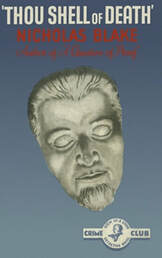
In Nicholas Blake's second mystery to feature his amateur sleuth Nigel Strangeways, the thoughtful academic is summoned by Fergus O'Brien, a fighter pilot who has been receiving anonymous letters which say that he will be dead by Boxing Day. O'Brien seems to find the threats more amusing than alarming, and to call fate's bluff – a gambit often evident in his flying days – he invites a group of people who might each be nursing a lethal grudge to a Christmas celebration at his home.

Indeed, Nigel has his hands full analyzing O'Brien's guests and learning their histories with the ex-airman. Uncharacteristically, the detective (and others) sleeps through the night's events, and Strangeways wakes only to discover O'Brien dead in a hut separated from the main house.


Only one set of tracks in the snow leads to the hut, yet other clues – a broken cuff button, shoes that are absent but reappear later – point to murder. This suspicion is quickly confirmed when one houseguest is nearly killed from a blow to the head by an unseen assailant, while another dies from cyanide poisoning. It's a complex, confusing case, but Nigel works with the amiable (and quite generous, as GAD police figures go) Superintendent Bleakley to untangle the tale and identify motive, means, and murderer.

Thou Shell of Death is great fun for classic mystery fiction fans, since it delivers on multiple counts: it is a sneaky fair-play puzzle with all of the clues and character psychologies offered up to the reader to organize and theorize about; it is spiritedly written and often quite humorous in description and design; the suspects are distinct personalities and used within the plot to good effect; and Blake (the pen-name for poet Cecil Day-Lewis) seems to be more comfortably familiar with his protagonist here than in his previous title, A Question of Proof. The character is now less of an eccentric for the sake of color – we learn in Proof that Strangeways has to sleep under a weight of bedcovers and must constantly drink tea, quirks that are thankfully not stressed here – and instead is a man intrigued foremost by people and their motivations and mannerisms. it's a better choice and it gives Nigel some humanity, while at the same time defining him not by his quirks but rather by his intellect.

Another aspect of Thou Shell I greatly enjoy is the author's handling of the fateful backstory that explains, among other things, O'Brien's wartime recklessness in combat, the murderer's relationship to the victim, and the body count resulting from that holiday house party. The way I view it, a mystery writer can use one of three general approaches to give the reader information about Past Events that tie directly to present deeds: 1) the detective can reveal the connection and explain the significance during the iconic end-of-chapter dénouement; 2) the author can dramatize the Past Event in separate chapter sections, with the reader understanding the significance toward the end; 3) the detective (and the reader) can learn details through interviews of witnesses or contemporaries as the story progresses.
Picture
There is no right or wrong choice regarding delivery of the Past Event, but it's instructive to note how each approach affects the narrative. Thou Shell of Death uses the third method, where Strangeways starts to understand the deceased O'Brien first through a lengthy anecdote from suspect and explorer Georgia Cavendish, and then from an interview with an elderly family nurse. In both sections, Blake recreates those moments of memory and allows the characters' stories to bring the Past Event into the present. In my opinion, it's a very effective approach, as it invites the reader to add these long-ago moments to the sum of the tragedy taking place now. There's a deeper resonance because we are allowed to understand the emotions and mindsets of the characters involved.

This also made me reflect on my frequent dissatisfaction with Approach #1, wherein the detective reveals the Past Event at the conclusion of the mystery story. It often feels to me as a narrative opportunity missed, as the result runs counter to the fundamental writing maxim of "Show, don't Tell." The reader may be surprised at the revelation, but he or she is largely denied the emotional catharsis (or generation of empathy) that might occur if one is invited to experience the event via flashback or retelling.


Right away, such contemplation brought me to the literary doorstep of the formidable Agatha Christie. It seemed like a number of her mysteries favored the last-chapter reveal to unveil the significance of a past event, but my Christie reading is far from complete and my memory of her stories (read decades ago) blurry. So I consulted AC expert Brad, whose ahsweetmysteryblog is a must-read for classic mystery fans, and I asked him to weigh in on Christie's handling of past events in her books. Boy, did Brad deliver.

He reminded me – for which I'm very grateful – that Agatha Christie was a constantly experimenting and creative structurist who varied her methods to meet her story needs. I feel that her classic 1939 tale And Then There Were None is profoundly resonant in part because some of her characters are haunted by and are reliving these past moments, and because Christie allows us to access some of those memories, most notably with Vera Claythorne. While some titles do deliver the Past Event as a drawingroom surprise, many others use tragic previous events to great dramatic effect as Christie concentrates on how the past ensnares and envelops those who are unable to break free. Ordeal by Innocence (1958) and Cards on the Table (1936) are just two examples that explore this past/present frisson, while 1943's Five Little Pigs (whose alternate title, appropriately, is Murder in Retrospect) is a particular favorite of Brad's, with the author using the specter of family tragedy to haunt the lives of their now-adult characters decades later.

The discussion was a fruitful and informative one, and I'm thrilled to see that Brad has decided to share his thoughts on the intersection of past and present in Christie's work in this excellent blog entry.
Picture
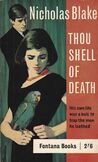
One additional note: Thou Shell of Death introduces the character of Georgia Cavendish, described through most of the book's first half as having a monkey-like face and perambulating with a parrot on her shoulder. Nigel becomes smitten with the adventuress here, and, like the transformation he undergoes from his début to his follow-up, Georgia will shed her eccentricities to become a more attractive figure in future installments. Her shining moment is certainly 1939's The Smiler with the Knife, a thriller in which she inhabits the leading role.
4 Comments

Book Review: A QUESTION OF PROOF (1935) by Nicholas Blake

12/30/2018

0 Comments

 
Picture
The English boys' or girls' preparatory school has proven to be an irresistible setting for Golden Age and contemporary writers of murder mysteries. Some authors were career educators, and were able to bring to life the conflicts large and small found when a group of adolescents (and their often equally childlike instructors) is forced to share a closed community. As a result, many writer/teachers have used their on-campus observations and understanding of the milieu to create some memorable campus-set detective stories, including Michael Innes's The Weight of the Evidence (1944), Josephine Tey's Miss Pym Disposes (1946), and Gladys Mitchell's Tom Brown's Body (1949), to name a few.

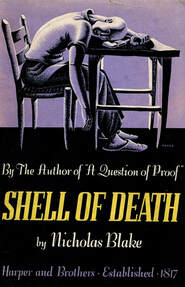
The début title in Nicholas Blake's series featuring the eccentric detective Nigel Strangeways can be added to this list. Blake was the pseudonym of Cecil Day-Lewis, an Irish-born writer who worked as a schoolteacher in Scotland and, in 1968, was named Poet Laureate of the United Kingdom. Fortunately, Day-Lewis chose to supplement his income by writing mystery fiction, and 1935's A Question of Proof is the book that introduces readers to his unassuming but quirky sleuth. I will let Michael Evans, a character in Proof who has become the prime suspect in the murder of an unlikable student, offer his description of Strangeways:
"Could not stick two years [at Oxford College], the spectacle of so many quite decent youths being got at and ruined for life was too much for him. Heard that at Cambridge the hearties were still heartier and the intelligentsia even less intelligent, so decided to dispense with any further education… Traveled about for a bit, learning languages. Then settled down for a bit to investigate crime; said it was the only career left which offered scope to good manners and scientific curiosity. He's been very successful; made pots of money. He did all the stuff in the Duchess of Esk's diamonds affair and several high-hat blackmail cases which have figured less prominently in the press."

"But what's he like?"

"Like? Oh, like one of the less successful busts of T.E. Shaw. A Nordic type. He's rather faddy, by the way; his protective mechanism developed them, I daresay. But you must have water perpetually on the boil; he drinks tea at all hours of the day. And he can't sleep unless he has an enormous weight on his bed. If you don't give him enough blankets for three, you'll find that he has torn the carpets up or the curtains down."

What's curious to me is that Nigel Strangeways comes across as rather a default eccentric in these mysteries; perhaps he is odd because the genre expects it. His "fads" are laid on the thickest in this début novel, but they are a collection of habits and don't better define the character's personality, which for me has always been more tabula rasa (or contemplative sponge) than memorably garrulous. Unlike, say, Hercule Poirot's fussy, precise mannerisms or Mrs. Beatrice Lestrange Bradley's physical and verbal assaults on those around her, Strangeways' behavior is not really in active service of his role as detective, nor does it physicalize his mental processes; it is peculiar to sleep under multiple blankets, but the fact doesn't really change or inform his introspective approach to investigating a crime.
There's another benefit to staging a murder mystery at a school, and it has to do both with a ready stable of on-hand suspects and the excellent narrative move of bringing chaos and disruption to a locale that operates on the regimentation of strict order and control. When Sudeley Hall student Wemyss disappears during a Sports Day exhibition and turns up dead, buried in a haystack in which Michael Evans was canoodling with the headmaster's wife, the tragic event threatens the reputation of the school and casts suspicion on the gossiping schoolmasters. Strangeways is called in to help clear his friend's name, but he is also seen as a mechanism to restore order to the troubled school by identifying the culprit. This he eventually does, but he is frustrated by a lack of empirical evidence – hence the title – and the killer is given enough rope to strike a second time.

There is a lot to appreciate in A Question of Proof, including lively comic descriptions and characterizations, literary and historical allusions, smart observations about British public school practices and quirks, and (perhaps most importantly) a mystery puzzle plot that stays busy and draws in several suspects before the detective reveals his final-chapter solution. Whether the reader feels that Blake has provided a fair-play puzzle experience will depend largely on how satisfied one is with the stated motive of the murderer. To his credit, the author makes sure all loose ends are tied up and explanations of the red herrings are provided.

Picture
While not the very best of the series, Day-Lewis/Blake nevertheless delivers an impressive first mystery and a worthy introduction of his capable, but always a little clinical and distant, detective. For me, the best Nigel Strangeways novels appear in the first half of his publishing output, and his creator should be celebrated for his enthusiasm for experimenting with style and structure within the series. Personal favorites include 1938's The Beast Must Die, a suspenseful version of the inverted-mystery tale, The Smiler with the Knife (1939), in which Nigel's wife Georgia is caught up in wartime espionage and intrigue, and Minute for Murder (1947), a clever meditation on the act of eliminating suspects.

Nick Fuller over at The Grandest Game in the World has also examined A Question of Proof (I would expect nothing less!) and has collected contemporary reviews of the book on his site.


0 Comments

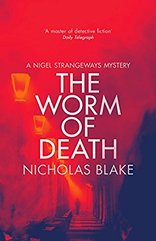
Book Review: THE WORM OF DEATH (1961) by Nicholas Blake

5/23/2018

0 Comments

 
Picture
When I led a much more leisurely paced life back in the early 2000s, I quickly read through all 16 books in Nicholas Blake's mystery series featuring amateur detective Nigel Strangeways. And for more than a decade, I haven't revisited any of the stories, despite admiring and enjoying several of them for their clever construction and solid storytelling. Still memorable are titles such as The Beast Must Die (1938), containing a smart and emotionally satisfying twist on the unreliable narrator; The Smiler with the Knife (1939), a wartime thriller in which Nigel's wife Georgia drives the action; and Minute for Murder (1947), a beautifully simple paring down of suspects, all in fair-play fashion, from six to three to two to one.

Nicholas Blake was the pen name for England's Poet Laureate Cecil Day-Lewis, and the Strangeways mysteries helped to provide additional income in the earlier days of his writing career. I decided to revisit the series with the late novel The Worm of Death (1961), which has been reprinted by Ipso Books – the publishing company now has a dozen Blake titles back in print – and made available in paperback and eBook formats. Worm finds Nigel living with his talented sculptor girlfriend, Clare Massenger, in Greenwich as a curious death attracts the couple's attention. The naked body of Dr. Piers Loudron has been pulled from the sea, and investigation shows cuts across each of his wrists that were likely not made by boat or nature. Had the doctor taken a drug and stumbled into the water after a suicide attempt? Or was the body moved as part of a cover-up to conceal a crime committed closer to home?

Looking into the case, Strangeways becomes acquainted with Dr. Loudron's unlikeable family, including his cold and clinical elder son, Dr. James Loudron; his younger son Harold, an ineffectual spouse overshadowed by his restless wife Sharon; his adopted son Graham, whose face (we are told repeatedly) resembles that of a fruit bat; and his daughter Rebecca, a nervous woman engaged to a volatile painter named Walter Barn. The detective picks through the clues and psychodramas to ultimately uncover a murderer, but not before another person is killed and Strangeways finds himself expected to play the role of third victim.

Nigel Strangeways made his first appearance in 1935, in the book A Question of Proof. This university-set début mystery is straightforward Golden Age detective fiction. Twenty-six years later, The Worm of Death synthesizes that traditional and popular clues-and-suspects genre form with something much more au courant: a psychological study of deviant characters shaking up societal norms. It's a useful distinction, because a person's enjoyment of this book (especially contrasted with the purer puzzle titles that preceded it) will depend on how comfortably one is with Christie-like clueing and Freudian analysis sharing the same page.

Psychological scrutiny, particularly in regard to character motives, certainly became more popular in crime fiction beginning in the post-war years, when puzzle-only fiction started to feel for many a bit hollow without emotionally complex or relatably flawed individuals to provide the appearance of verisimilitude. In Blake's mystery and suspense novels, this manifested in a display of overt (and usually dangerous or unattractive) sexuality: some women, like Sharon in this book, became calculating nymphomaniacs, aggressively throwing themselves at Strangeways, with Clare watching in bemused fashion. In Blake's men, there is evidence of literal or figurative impotence (Harold), aggressive overcompensation (Walter Barn), or, in the murderer's case, some fundamentally Freudian Oedipal issues. The diagnosing can feel a bit heavy-handed in these later books, especially since Strangeways is a bit of a cold fish himself: his relationship with Clare Massenger as written isn't nearly as egalitarian or inviting as the one Blake created for Nigel and his wife Georgia.  


Picture
Still, this Worm is entertaining (even as its narrative is rather sober and detached), and it has two very intriguing facets to recommend it. Blake sets the story in the famed naval city of Greenwich, where he lived when he wrote the novel, and indeed goes so far as to install the Loudron family into his own home. The blinding coastal fog, the access to the quay, the high-tide waters lapping against the house: all is described vividly and with convincing, atmospheric detail. Also, Blake/Day-Lewis hasn't lost his skill for pacing, and while not as strong as his most powerful mysteries, The Worm of Death is still an engrossing read, and begins with a diary excerpt from the dead man (who knows an unnamed killer is plotting to attack him) calculated to tantalize a reader still hoping for a classic Golden Age guessing game, even at this late year.

I received a review eBook copy via NetGalley in exchange for an honest review. Sincere thanks to Ipso Books for bringing back into print the great Nigel Strangeways mysteries. They are well worth checking out.
0 Comments
Forward>>

    BLOG

    Lots of book reviews and discussion of classic and contemporary mystery fiction. I welcome comments and continuing conversation.

    Subscribe below to receive updates!

    Subscribe

    Categories

    All
    19th Century Novels
    Andrew Garve
    Anne Morice
    Anthologies
    Anthony Boucher
    Appalachian Authors
    Bill James
    Book Review
    Catherine Dilts
    C. Daly King
    Craig Rice
    David Goodis
    E.C.R. Lorac / Carol Carnac
    Erle Stanley Gardner
    E.R. Punshon
    Freeman Wills Crofts
    French Authors
    George Bellairs
    George Milner
    Gladys Mitchell
    Golden Age Mystery
    Gregory McDonald
    Hardboiled Detectives
    Helen McCloy
    Helen Simpson
    Henry Wade
    Herbert Adams
    Hugh Austin
    James Corbett
    J. Jefferson Farjeon
    John Bude
    John Rhode/Miles Burton
    Leo Bruce
    Maj Sjowall / Per Wahloo
    Margery Allingham
    Martin Edwards
    Michael Gilbert
    Michael Innes
    Mignon G. Eberhart
    Milward Kennedy
    Mitchell Mystery Reading Group
    New Fiction
    New Mystery
    Nicholas Blake
    Nicolas Freeling
    Noir
    Philip MacDonald
    Play Review
    Q. Patrick / Patrick Quentin
    Rex Stout
    Richard Hull
    Ross MacDonald
    Russian Authors
    Science Fiction
    Vernon Loder
    Vladimir Nabokov
    William L. DeAndrea
    Winifred Blazey
    Writing

    Mystery Fiction Sites
    -- all recommended ! --
    Ahsweetmysteryblog
    The Art of Words
    Beneath the Stains of Time
    Bitter Tea and Mystery
    Catherine Dilts - author
    Countdown John's Christie Journal
    Classic Mysteries
    Clothes in Books
    ​A Crime is Afoot
    Crossexaminingcrime
    Gladys Mitchell Tribute
    Grandest Game in the World
    Happiness Is a Book
    In Search of the Classic Mystery Novel
    The Invisible Event
    Martin Edwards' Crime Writing Blog
    Murder at the Manse
    Mysteries Ahoy!
    Noirish
    The Passing Tramp
    Past Offences
    Pretty Sinister Books
    Tipping My Fedora
    To the Manor Born
    Witness to the Crime
    

    Archives

    August 2025
    December 2024
    November 2024
    September 2024
    May 2024
    April 2024
    January 2024
    August 2023
    June 2023
    May 2023
    April 2023
    March 2023
    February 2023
    January 2023
    December 2022
    November 2022
    August 2022
    July 2022
    June 2022
    May 2022
    April 2022
    February 2022
    January 2022
    December 2021
    November 2021
    October 2021
    September 2021
    August 2021
    July 2021
    June 2021
    May 2021
    April 2021
    March 2021
    February 2021
    January 2021
    December 2020
    November 2020
    October 2020
    September 2020
    August 2020
    July 2020
    June 2020
    May 2020
    April 2020
    March 2020
    February 2020
    January 2020
    December 2019
    November 2019
    October 2019
    September 2019
    August 2019
    July 2019
    June 2019
    May 2019
    April 2019
    March 2019
    February 2019
    January 2019
    December 2018
    November 2018
    October 2018
    September 2018
    August 2018
    July 2018
    June 2018
    May 2018
    April 2018
    March 2018
    February 2018
    January 2018
    December 2017
    October 2017
    September 2017
    August 2017
    July 2017
    June 2017
    April 2017
    March 2017
    February 2017
    January 2017
    December 2016
    November 2016
    October 2016
    September 2016
    August 2016
    July 2016
    June 2016
    May 2016
    April 2016
    March 2016
    February 2016
    January 2016
    November 2015
    October 2015
    July 2015
    June 2015

    RSS Feed

Unless otherwise stated, all text content on this site is
​copyright Jason Half, 2026.